
call us
+86-18811954888
2026-10-29
At 2 a.m. on a rain-slicked arterial road, a driver sees a pedestrian late because the light is bright at the pole base but weak at the crossing. The pole is new, the lantern is powerful, and the street is still unsafe. That gap between installed hardware and delivered benefit is the central issue in street lighting. The benefits of street lights are real, measurable, and often substantial, but they come from the whole system: light distribution, pole height, foundation, maintenance, energy source, and controls.
The short answer is that street lights improve night-time safety, reduce fear, extend mobility, support local activity, lower operating costs when efficient, and enable smart public services. The longer answer is how to keep those benefits from being lost to poor glare control, undersized poles, weak maintenance planning, or a lowest-price purchase that ignores lifecycle cost. A useful way to evaluate any street lighting scheme is to ask which benefit it is meant to deliver, how that benefit will be measured, and what happens when the installation is ten years old.
This article treats street lighting as infrastructure rather than decoration. It covers the safety evidence, the social and economic value, the environmental trade-offs, the light-quality metrics that separate “bright” from “useful,” the structural choices that keep poles standing, and the procurement details that determine whether an installation still performs after the first winter storm. The focus is practical: what a buyer, engineer, or community decision-maker should specify, compare, and inspect.
Street lighting is rarely purchased for one reason alone. A council may approve a project because of crash records, a developer may install lights because a road must be adopted, and a manufacturer may supply poles because a factory expansion needs safe shift-change routes. In most business cases, the strongest justification combines several outcomes.
The first outcome is crash reduction. Lighting helps drivers detect pedestrians, cyclists, lane edges, signs, and debris earlier. It also helps pedestrians judge vehicle speed and driver intent. The second outcome is personal security. Well-lit routes reduce fear of crime and support natural surveillance, even though lighting alone cannot solve every security problem. The third is mobility. Lighting extends the usable hours of footpaths, cycleways, bus stops, and town centres, which matters for shift workers, older people, students, and people without cars.
The fourth outcome is economic. Efficient LED systems reduce electricity use, maintenance visits, and lamp replacement costs. Good lighting can also support evening activity in commercial areas and make public spaces feel cared for. The fifth is environmental performance, but only when the design controls skyglow, uplight, and wasted light. The sixth is smart-infrastructure readiness. A modern pole can carry sensors, cameras, charging points, communications equipment, and solar components, but only if the structure and foundations are sized for the extra load.
None of these benefits is automatic. A high-wattage lantern mounted too low can create glare that makes the road harder to see. A solar light without enough battery autonomy can fail during a cloudy week. A decorative pole selected for appearance may not withstand the wind load at a coastal site. The rest of this article explains how to protect the benefits through specification and procurement.
The strongest evidence for street lighting is road safety. Night-time driving reduces visual contrast, shrinks the distance at which drivers can identify obstacles, and makes pedestrians harder to see against dark backgrounds. Street lighting improves the driver’s preview distance and helps pedestrians see approaching vehicles. Road-safety reviews have reported substantial reductions in night-time crashes after lighting improvements, with pedestrian-focused schemes sometimes showing reductions of around 50% in pedestrian crashes at lit crossings. The exact figure varies by road type, speed, existing lighting, and enforcement, but the direction is consistent.
The safety benefit depends on where the light lands. Good road lighting provides horizontal illuminance on the carriageway, vertical illuminance on pedestrians and cyclists, and enough uniformity that the driver’s eye does not have to adapt repeatedly between bright pools and dark gaps. A street with high average brightness but poor uniformity can feel less safe than a street with lower but more even lighting. Glare is equally important. A luminaire that sends light directly into the driver’s eye reduces contrast and can be worse than no light at all.
Standards help structure the discussion. Road-lighting design frameworks such as EN 13201 distinguish road classes by traffic volume, speed, and user mix, then set targets for luminance or illuminance, uniformity, and glare. A residential street, a school crossing, a roundabout, and a high-speed arterial should not share the same design. Crossing areas need vertical illumination on the pedestrian, not just a bright patch on the asphalt. Roundabouts need legibility of the central island and approach lanes. Cycle routes need enough light to reveal surface defects without blinding oncoming users.
Pole placement is part of safety, not a cosmetic afterthought. Mounting height, spacing, outreach, and tilt determine whether light reaches the carriageway or spills into gardens and windows. A pole placed too far from the crossing may meet an average lux target while leaving the crossing itself under-lit. A pole placed too close to the kerb may be vulnerable to vehicle impact and may need a protective barrier or a setback. Maintenance access also matters: a light that cannot be reached safely may stay out of service for weeks.
The safety case also includes the route between destinations. A well-lit road with a dark footpath beside it does not deliver a safe walking environment. Lighting should be considered along the whole journey: bus stops, underpasses, parking areas, station approaches, and crossing points. This is why a layout that looks adequate on a single road plan can fail when pedestrians actually use it. The practical test is to walk the route at night, in wet weather, and observe where the eye struggles to identify people, kerbs, steps, and vehicles.
Pole placement and height are not cosmetic; they determine whether light lands on the road or in a driver’s eyes, a point covered in this look at how street light poles improve city safety at night. The broader lesson is that safety comes from the lighting layout, not from the wattage printed on a label.
Street lighting supports security by improving visibility, increasing the chance that unusual activity is noticed, and helping people feel confident enough to use public space. It does not replace policing, community management, access control, or good urban design. A brightly lit area with poor sightlines, hidden corners, and no nearby activity can still feel threatening. A moderately lit area with clear sightlines, active frontages, and regular foot traffic may feel safer.
The psychological benefit is significant. Fear of crime can keep people indoors, reduce walking, and weaken local social life. Lighting that removes dark pockets along a route can make the difference between a ten-minute walk home and an expensive taxi ride. This benefit is strongest when lighting is consistent along the route, not concentrated in one showpiece square. A bright plaza surrounded by dark connecting streets does not create a safe network; it creates an island.
Security lighting should be designed for facial recognition at a reasonable distance, not for maximum brightness. Vertical illuminance on the faces and bodies of people approaching one another matters more than glossy pavement. Colour rendering also helps: a light source that renders skin tones and clothing colours accurately makes it easier to identify people and describe situations. CCTV coverage works better when the lighting is uniform and avoids strong backlight from luminous sources.
There is also a maintenance dimension. A failed lamp in a key underpass or car park can quickly undermine confidence. Remote monitoring, simple fault reporting, and a clear maintenance response time are part of the security benefit. The cheapest installation may become the most expensive security measure if outages last for weeks. For public spaces, a lighting scheme should include an outage plan, a spare-parts list, and access arrangements for maintenance crews.
Finally, lighting should avoid creating a false sense of control. Very bright floodlighting can cause glare, cast deep shadows, and make surrounding areas appear darker than they are. The aim is a legible environment with consistent visibility, not a wall of light. Security comes from the combination of lighting, sightlines, active uses, and management. Lighting is an enabler, not a substitute.
Street lighting extends the working day of a neighbourhood. It allows people to walk to a bus stop after dark, cycle home from a late shift, take children to evening activities, and visit local shops in winter. This mobility benefit is easy to overlook because it is spread across many small decisions. A parent who would not walk a dark route with a child may drive instead. A worker who finishes at 11 p.m. may turn down a job because the walk from the bus stop feels unsafe. A student may avoid evening library access.
Good lighting also helps navigation. Drivers see lane markings, kerbs, bollards, and direction signs earlier. Pedestrians see steps, uneven paving, and crossing points. Cyclists see potholes and glass. Older people and people with reduced vision benefit disproportionately because they need more contrast and more time to react. A lighting design that only considers the average driver misses a large part of the public.
The social benefit is connected to public life. Well-lit squares, parks, promenades, and market streets can support evening events, outdoor dining, and community gatherings. The key is to match the lighting to the use. A park path needs safe vertical illuminance and clear escape routes; a market square may need flexible lighting for events; a residential street needs low glare and minimal intrusion into bedrooms. One lighting class cannot serve all three.
Mobility also depends on continuity. A lit town centre with a dark link to the railway station does not create a usable walking network. Local authorities and developers should map the whole route and identify gaps, not only the segments inside a single project boundary. In practice, this means coordinating road lighting, footpath lighting, landscape lighting, and private frontage lighting so that the pedestrian experience is consistent.
The economic case for modern street lighting usually rests on three numbers: energy consumption, maintenance frequency, and asset life. LED luminaires typically deliver system efficacies in the range of 100 to 150 lumens per watt, and well-designed products can exceed that. High-pressure sodium systems are often in the 50 to 80 lumens per watt range once ballast losses and optical efficiency are included. The gap explains why LED retrofits can reduce electricity use by half or more, depending on the existing installation and controls.
Maintenance savings are often larger than energy savings over the life of the asset. LED luminaires commonly have a longer service life than sodium lamps, and they do not need frequent lamp changes. That reduces the number of elevated-platform visits, traffic management costs, and disruption. The saving is especially strong on high-speed roads, bridges, and urban centres where a maintenance visit requires lane closures or night work. However, the saving depends on driver quality, thermal design, surge protection, and the local environment. A cheap driver in a hot, humid location may fail long before the LED array does.
Controls add another layer. Dimming during low-traffic hours, part-night operation in appropriate locations, and presence-based lighting can cut energy use without reducing safety where the schedule is carefully designed. The economic case should include the cost of commissioning, communications, and cybersecurity if the controls are networked. A control system that is not maintained can become a stranded asset.
| Approach | Typical system efficacy | Strength | Best fit | Procurement watch-outs |
|---|---|---|---|---|
| High-pressure sodium | About 50 to 80 lm/W | Low first cost, proven performance, warm colour | Retrofits where existing assets are serviceable | High energy use, ballast maintenance, limited control |
| LED | About 100 to 150+ lm/W | High efficiency, long life, dimming and monitoring | Most roads, footpaths, car parks, and urban centres | Driver quality, thermal design, glare control, surge protection |
| Solar all-in-one | Depends on panel and battery sizing | No trenching, fast deployment, grid independence | Paths, villages, parks, bus stops, temporary sites | Battery autonomy, shading, theft, cleaning, winter performance |
| Separated solar | Depends on panel, battery, and load | Flexible panel placement and larger energy storage | Off-grid roads, compounds, rural routes | System sizing, cable losses, battery replacement, service access |
For a buyer, the lowest purchase price is rarely the lowest lifecycle cost. A cheaper luminaire with a short driver life, poor surge immunity, or inaccessible screws can cost more in five years than a better product. The same applies to poles. A thin-walled pole that deflects under wind load may pass a visual inspection when new and fail at the base plate years later. The economic evaluation should include inspection, cleaning, lamp or module replacement, driver replacement, battery replacement for solar systems, and end-of-life disposal.
LED performance is now mature enough that the main differentiator is not the LED chip alone. It is the thermal path, the lens design, the surge protection, the paint or coating, the sealing, and the quality of the driver. A 120 W LED street light with good optics can put more useful light on the road than a 200 W product with poor glare control. That is why photometric files and independent test reports matter more than a headline wattage.
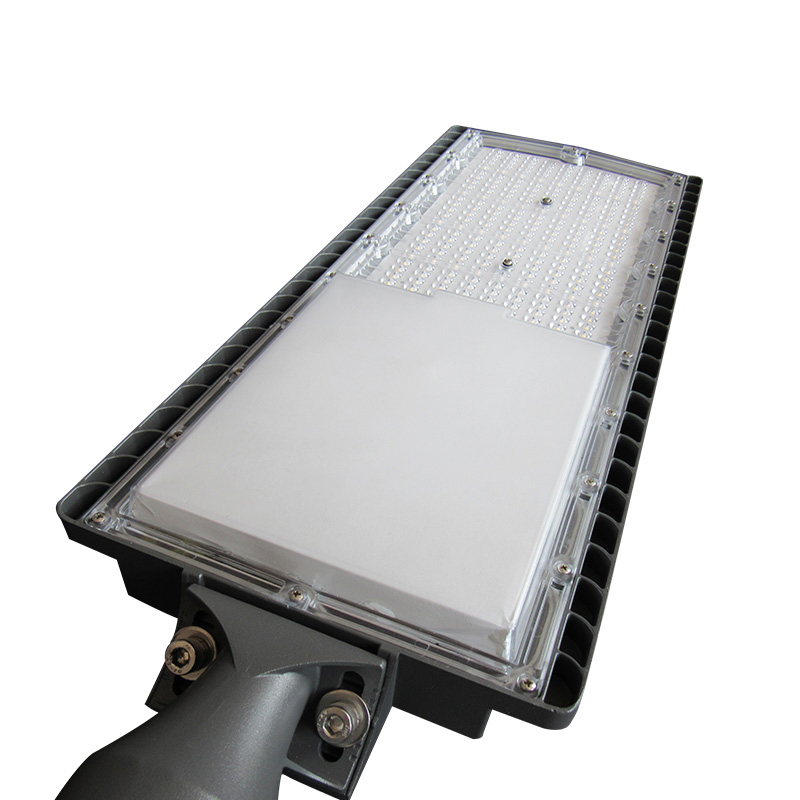 DDK-LD121 LED Street Light with Adjustable Mounting and DimmingWith 150 LM/W efficacy, adjustable tilt, dimming, and an IP66 die-cast housing, it suits road, pathway, and parking-area installations.View Product →
Local economic vitality is harder to quantify but still relevant. A well-lit high street can support evening shopping and dining. A lit industrial estate can support shift work. A lit car park can reduce the risk of vehicle crime and make a site feel managed. These benefits depend on the quality of the environment, not just the presence of light. A street that is bright but hostile, noisy, and poorly maintained will not become vibrant because the lux level was increased.
Street lighting has an environmental paradox. It improves safety and extends public life, but it also consumes energy, introduces light into the night environment, and creates hardware that must eventually be recycled or replaced. The environmental benefit is therefore not “lighting is good” or “lighting is bad.” It is a question of whether the installation delivers the required visibility with the least waste.
The first environmental lever is energy. LED and controls can cut electricity use substantially compared with older sodium systems. The second is light pollution. Uplight, glare, and spill light waste energy and disturb ecosystems. A full cut-off luminaire, careful aiming, and a backlight shield can keep light on the target area. Warm colour temperatures around 3000 K are often preferred in residential and ecological areas because they reduce the blue-rich component associated with skyglow, although the effect depends on the spectrum and the amount of light, not colour temperature alone.
The third lever is duration. Part-night dimming or adaptive lighting can reduce output when traffic and footfall are low. This must be designed with safety in mind. A dimming profile that is appropriate for a residential street may be unsuitable for a busy interchange or a crossing used by shift workers. The fourth lever is material. Poles, luminaires, drivers, and batteries have embodied carbon and end-of-life impacts. A long-life product that is repairable and has accessible spare parts usually performs better than a sealed product that must be replaced as a unit.
Solar lighting adds another set of considerations. It avoids trenching and grid connection, which can reduce construction impacts in parks, villages, and remote routes. But a solar system is only as good as its sizing. A panel that is too small, a battery that is too shallow, or a controller that is poorly matched to the load will lead to early failure. Battery chemistry, replacement intervals, and recycling pathways should be part of the environmental comparison, not an afterthought.
The most defensible environmental position is a well-designed, well-controlled, long-life installation that provides the required lighting class and no more. Over-lighting is not a premium feature. It is waste, glare, and higher lifecycle cost. Under-lighting is also a failure because it compromises safety and can lead to complaints or additional temporary lighting. The target is the right level, in the right place, at the right time.
Brightness is a poor specification. The eye adapts to the brightest object in view, so a luminaire with high luminous output can make the surrounding road appear darker if it produces glare. Useful street lighting is defined by illuminance or luminance on the task area, uniformity across the area, glare limitation, colour quality, and consistency over time. These are the metrics that connect a product datasheet to a real street.
Illuminance is the amount of light falling on a surface, measured in lux. Luminance is the brightness of a surface as seen by the observer, measured in candelas per square metre. Road-lighting standards often use luminance for vehicle drivers because it relates more closely to visual performance on wet and dry surfaces. Illuminance is widely used for pedestrian areas, cycle paths, and crossings where vertical visibility matters. The important point is that the design should use the metric that matches the task, not a single number copied from a catalogue.
Uniformity is the ratio of minimum to average light level. A road with a high average but a dark patch every few metres forces the driver’s eye to adapt repeatedly. That is tiring and can hide hazards. Uniformity is influenced by pole spacing, mounting height, outreach, and the shape of the light distribution. A wider spacing may reduce pole count, but it can create dark gaps and glare if the optics are not designed for it. The cheapest layout is not always the one with the fewest poles.
Glare control is equally important. Disability glare reduces the ability to see detail, while discomfort glare causes annoyance and fatigue. Both are affected by luminaire brightness, mounting angle, shielding, and the background environment. A luminaire that looks comfortable in a showroom may be painful on a dark road. This is why photometric files, glare ratings, and independent testing are more valuable than a visual impression.
Colour temperature and colour rendering affect acceptability. A 3000 K light is often perceived as warmer and more residential. A 4000 K light can feel crisper on traffic routes. Higher colour rendering helps with facial recognition and CCTV, but it may not be necessary on a freight corridor. Flicker, colour shift, and inconsistent binning can make an installation look patchy. For a public project, the same product family should be used across a route so that colour and optics remain consistent when replacements are made.
Finally, light quality includes maintenance. A luminaire that loses 30% of its output in five years may still be “working,” but the road may no longer meet its design class. Lumen maintenance, driver failure rates, and dirt depreciation should be included in the design. In coastal or industrial areas, salt, dust, and pollution can accelerate depreciation. The specification should state the maintained illuminance, not only the initial output.
A street light is a visible piece of public design. The pole height, taper, colour, base cover, and lantern shape affect how a street feels. A heavy highway pole in a historic square looks wrong even if it is technically efficient. A slender decorative pole on a high-speed arterial may be under-sized and vulnerable. The design process should therefore start with the place and the task, then select the structure and optics to match.
In residential and garden settings, lower mounting heights and warmer colour temperatures can create a softer environment. Decorative pole lights, garden lamp heads, lawn lights, and base covers can make a scheme feel intentional rather than utilitarian. In commercial and arterial settings, the priority shifts to uniformity, glare control, and maintenance access. The same luminaire family can be used across both if the optics and mounting accessories are selected properly, but the design assumptions should not be copied blindly.
Pole geometry affects both appearance and performance. A taller pole can spread light over a wider area and reduce glare, but it may require a larger foundation and a stronger base plate. A shorter pole can be more human in scale, but it may not achieve the required uniformity on a wide carriageway. Outreach length matters: a long outreach can place light over the road, but it also increases bending moment at the base. The structural engineer and the lighting designer need to work from the same layout.
Decorative elements should not compromise performance. A base cover can hide anchor bolts and improve appearance, but it must allow drainage and inspection. A decorative lantern head may look elegant, but its optical chamber must be sealed against water and insects. In coastal areas, the coating and stainless-steel fasteners matter as much as the shape. A beautiful pole that corrodes in three years is not a good investment.
Poles are structures, not accessories. They must resist wind load, vibration, and, in some locations, vehicle impact. The foundation must match the soil conditions, the pole base plate, and the anchor bolt arrangement. A common failure mode is a foundation designed for a standard pole but installed with a different base plate or anchor bolt projection. The result can be a pole that cannot be levelled, a base cover that does not fit, or a connection that is stressed before it carries any wind load.
Hot-dip galvanizing is a baseline corrosion-protection measure for steel poles. Thickness, adhesion, and surface preparation should be specified and inspected. Coastal sites, industrial zones, and areas with de-icing salt need a higher level of protection or a different material strategy. The pole’s verticality, base plate flatness, weld quality, and door opening position should be checked at delivery. A door opening that faces the road may be inconvenient for maintenance; one that faces a wall may be inaccessible.
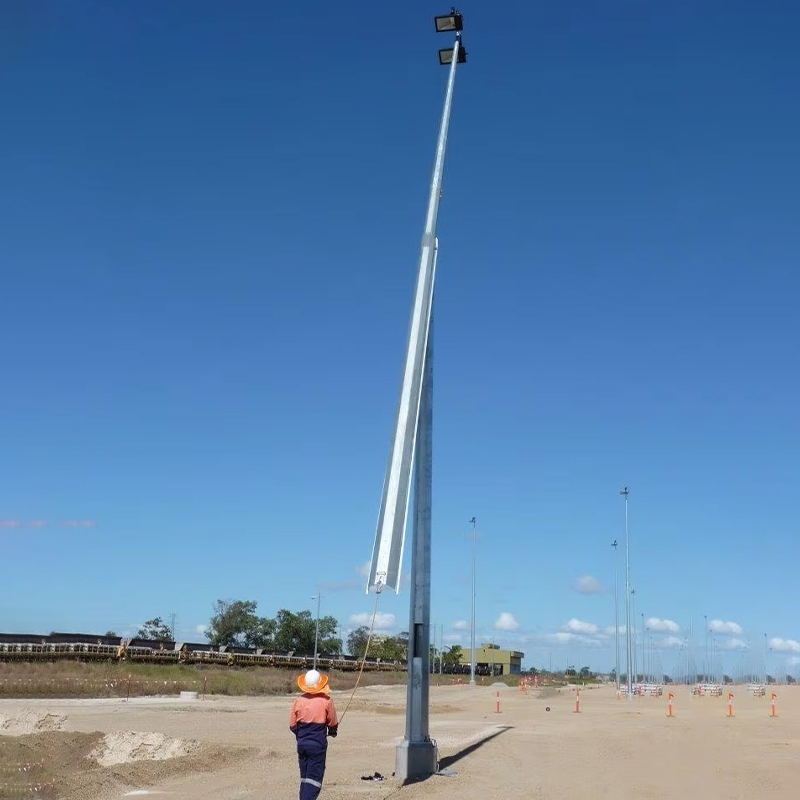
Hinged poles can reduce maintenance risk because the pole can be lowered without a crane or an elevated platform. That is valuable on narrow roads, in landscaped areas, and at sites where traffic management is expensive. The hinge mechanism, locking system, and corrosion protection must be designed for the local environment. A hinge that seizes after two winters defeats the purpose.
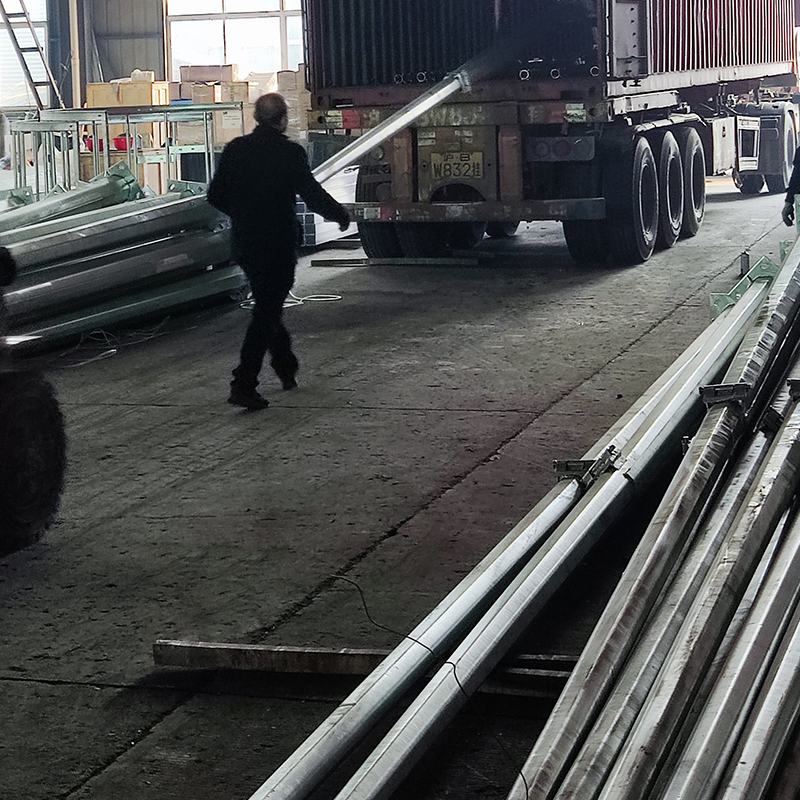 Galvanized Steel Hinged Poles for Lighting and Temporary StructuresThe hinged design supports easier setup and lowering, while galvanized steel construction suits outdoor lighting, flagpole, and temporary-structure applications.View Product →
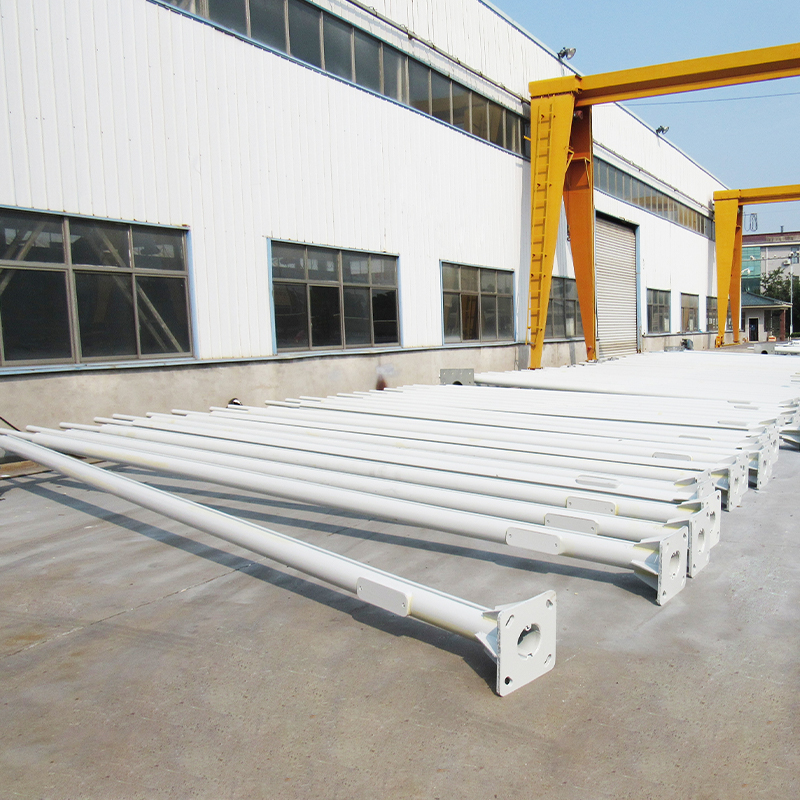
For projects that need a specific appearance, custom fabrication can be the difference between a standard installation and a coherent streetscape. Round, hexagonal, octagonal, square, and tapered poles can be produced to drawings, with matching base covers and brackets. The procurement question is not whether custom work is possible, but whether the supplier can control tolerances, welding, galvanizing, packing, and documentation across the whole order. A mixed delivery of poles from different batches can create visible colour and fit differences on the same street.
Solar street lighting is most compelling where grid connection is expensive, disruptive, or unreliable. A park path, a village road, a bus stop, a construction compound, or a remote industrial access route may need light but not a trench, a transformer, or a metered supply. In those cases, a solar system can be installed quickly and operated independently. The benefit is not only energy; it is speed, civil-works avoidance, and resilience.
The technology has improved, but it still requires honest sizing. A solar light must generate enough energy on the worst week of the year, store enough for cloudy days, and deliver the required light level through the night or through the agreed operating profile. Panel wattage alone is not enough. Battery capacity, depth of discharge, controller efficiency, LED load, and cable losses all matter. A system that works in summer may fail in winter if the design assumes clear skies all year.
Panel choice affects siting. Flexible solar panels in the 120 W to 140 W range can fit curved or space-limited pole surfaces and are useful where a rigid panel would be vulnerable or visually intrusive. Monocrystalline panels from 20 W to 100 W suit smaller standalone lights, while panels up to 550 W are used in larger systems. The mounting angle, shading, and cleaning access should be considered at the layout stage. A panel mounted where it catches the shadow of a tree or a building will underperform regardless of its rating.
Solar lighting also has security and maintenance implications. Batteries and controllers are valuable and may be stolen if the enclosure is not secure. The pole must be strong enough for the panel’s wind load, which can be significant on a large array. Cleaning may be needed in dusty or coastal environments. Battery replacement is a future cost that should be planned, not discovered. For public projects, the maintenance team should be able to test the system, replace the battery, and update the controller without special tools that are not available locally.
The best solar projects use solar where it solves a real constraint. They do not force solar onto a high-traffic road with low winter sun and high lighting requirements unless the engineering case is strong. A hybrid approach, grid-connected LED with solar augmentation, can be more reliable in some locations. The decision should compare lifecycle cost, reliability, maintenance access, and light quality, not just the absence of an electricity bill.
Street lighting is becoming a platform. A pole can carry cameras, environmental sensors, public Wi-Fi, electric-vehicle charging, pedestrian call buttons, and small solar systems. The benefit is not technology for its own sake. It is the ability to add services without another round of civil works. A town centre that already has power and a structure at the right location can add a charging point or a sensor more cheaply than a site with no infrastructure.
Smart lighting also improves operations. Remote monitoring can report outages, energy use, and driver faults. Asset management can schedule maintenance before a whole street goes dark. Adaptive lighting can respond to traffic or footfall. These functions can reduce cost and improve reliability, but they introduce cybersecurity, data ownership, and interoperability questions. A proprietary control system that cannot integrate with the authority’s existing platform may become a liability. Open protocols, documented APIs, and clear data ownership should be part of the specification.
Public amenities can also be integrated into the streetscape. Solar benches, charging stations, and solar trees combine seating, lighting, and small-scale power in places where people wait or gather. They are useful at bus stops, parks, campuses, and squares, provided the load is realistic and the battery is sized for the local climate. A charging bench that fails in winter is worse than a simple bench. The amenity should be designed for cleaning, vandalism resistance, and spare-part availability.
 DDK-2000A Solar Charging Bench with WiFi Hotspot and RoofCombining outdoor seating, roof-mounted solar charging, USB and wireless ports, and a WiFi hotspot, it supports public spaces such as parks or campuses.View Product →
For a public space, the value of a smart bench or charging station is convenience and presence. It gives people a reason to linger, charge a phone, or wait safely. But the lighting around it still matters. A smart bench in a dark corner does not create a safe place. The amenity should be part of a lighting layout that provides vertical illuminance, clear sightlines, and a comfortable colour temperature. Technology should support the place, not distract from it.
Most street lighting benefits are lost before the first concrete pour. A project may have a good safety objective, a sensible energy target, and a attractive design, but the tender documents may allow a substitute product with different optics, a thinner pole, or a smaller foundation. The result is an installation that meets the price but not the performance requirement. Procurement is therefore part of the engineering process, not a separate administrative step.
The specification should include the lighting design, the road classes, the maintained illuminance or luminance, the uniformity target, the glare limit, the colour temperature, the control strategy, and the maintenance regime. It should require photometric files in IES or LDT format so that the buyer can verify the layout independently. It should state the pole height, material, wall thickness, galvanizing standard, base plate dimensions, anchor bolt arrangement, and wind-load calculation. It should define the foundation design responsibility and the soil assumptions.
Quality evidence matters. For luminaires, buyers should request test reports for photometric performance, ingress protection, impact resistance, surge protection, and driver lifetime. For poles, they should request material certificates, weld inspection records, galvanizing reports, and dimensional checks. For solar systems, they should request battery datasheets, controller specifications, autonomy calculations, and low-temperature performance. A certificate that is not tied to the actual model or batch is of limited value.
Commercial terms also affect the benefit. Delivery schedules should match the civil-works programme. Packing must protect painted and galvanized surfaces during sea freight. Spare parts, special tools, and installation manuals should be included. Warranty terms should cover the complete system, not just the LED module. If the project is in a coastal or high-humidity area, the warranty should reflect the environment. A 5-year warranty on a product that is installed in a salt-spray zone without the right coating is not a meaningful guarantee.
Supplier capability is especially important when the project mixes standard and custom elements. A supplier that can work from drawings, produce samples, coordinate pole and luminaire interfaces, and manage export logistics reduces the integration risk between different trades. DDK Tech Elefacility Yangzhou Co., Ltd. describes its [custom manufacturing and export experience](/strength/) in outdoor lighting, including steel poles, garden lights, LED and HPS street lights, solar poles, and solar public amenities. That kind of vertical range can simplify procurement when a project needs poles, luminaires, and solar components from one source, but the buyer should still verify the specific product data and factory evidence.
The tender should also require a commissioning plan. Angles should be set, controls should be tested, and as-built photometrics should be checked where practical. A night-time inspection after energization can reveal glare, dark patches, and aiming errors that are invisible on a drawing. The maintenance team should receive training and a spare-parts package. The benefit of a good design is only realised when the installation is operated as intended.
Many street lighting problems are predictable. They appear in projects that focus on the luminaire wattage and neglect the system around it. The following risks are worth checking before an order is placed.
These risks are not theoretical. A glare problem may generate complaints and require a second visit with shields or re-aiming. A pole with a mismatched base plate may need site modification. A solar light that fails in winter may require battery replacement across the whole batch. The cost of correcting these issues usually exceeds the saving from the cheaper specification.
A structured process helps a team move from “we need street lights” to a design that delivers measurable benefits. The following sequence works for a single street, a park, or a municipal programme.
The framework is deliberately simple. Its value is in forcing the project team to connect the promised benefit to a technical requirement and a verification step. A street light is not beneficial because it exists. It is beneficial because it improves visibility, reduces fear, supports mobility, and does so without wasting energy or creating new hazards.
The benefits of street lights are strongest when the installation is treated as a system. Safety improves when light reaches the pedestrian, the kerb, and the obstacle without glare. Security improves when routes are consistently lit and well maintained. Mobility improves when the whole journey is considered, not just the road. Economic value improves when energy and maintenance costs are reduced over the asset life. Environmental performance improves when light is controlled, shielded, and switched or dimmed appropriately. Smart services become useful when they sit on a structure that can carry them safely and a power system that can support them.
The weakest approach is to buy on wattage and price alone. The strongest approach is to define the benefit, set the performance target, engineer the pole and foundation, verify the product data, and plan the maintenance. That is less exciting than a glossy catalogue, but it is how street lighting actually earns its place in a community.
For a buyer, the practical takeaway is to ask three questions before approving a scheme: Does the light land where people and vehicles need it? Will the structure and power system still perform in ten years? Can the installation be maintained without closing the road or replacing the whole unit? If the answer to all three is yes, the benefits of street lighting are likely to be real, visible, and lasting.
Related Products
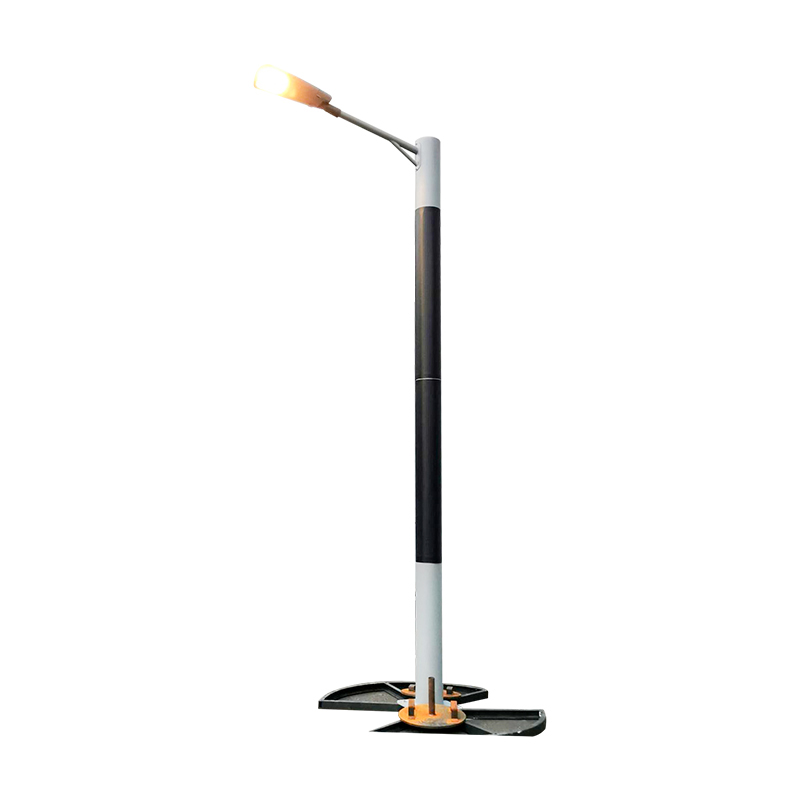 DDK-SSPL-2000 Cylinder Solar Pole Single/Double Arms And Street LED Lamps
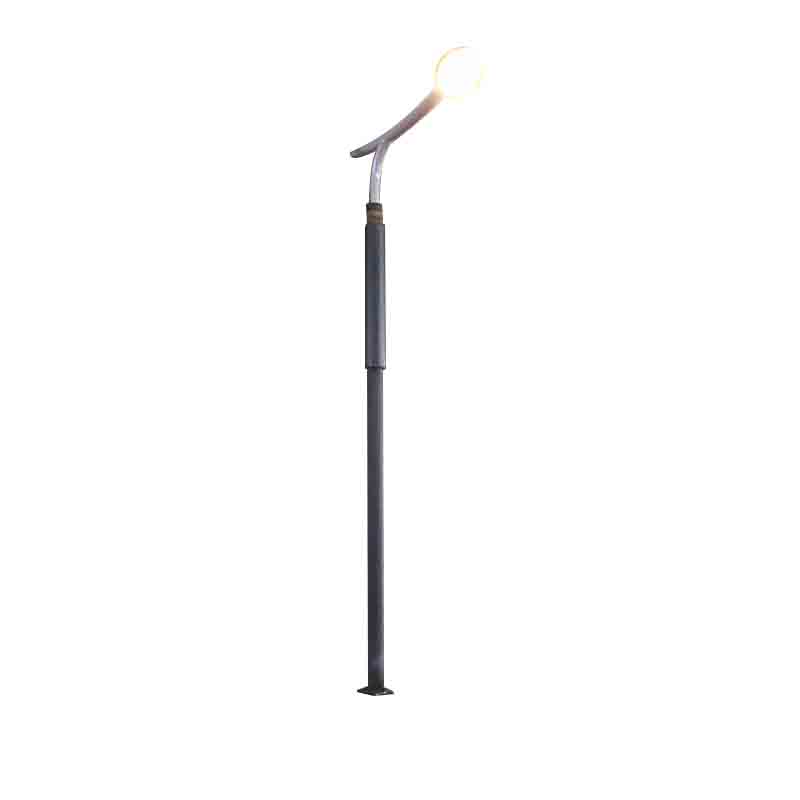 DDK-SSPL-2002 Cylinder Solar Pole With Lamp Head
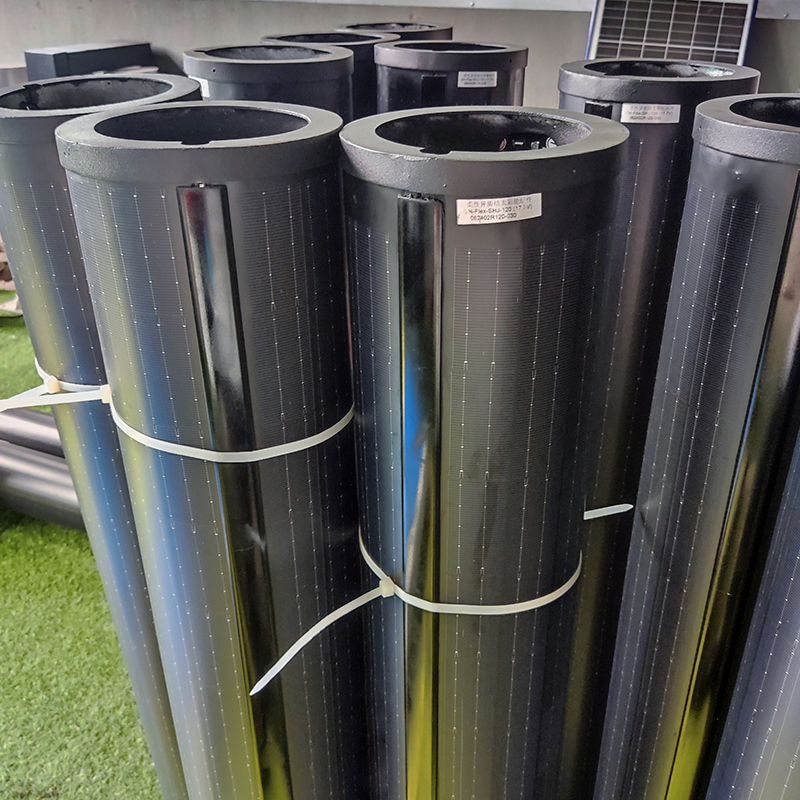 140W Flexible Solar Panel: High-Performance, Elegant and Versatile Power Solution for Lighting Poles and Park Lightings
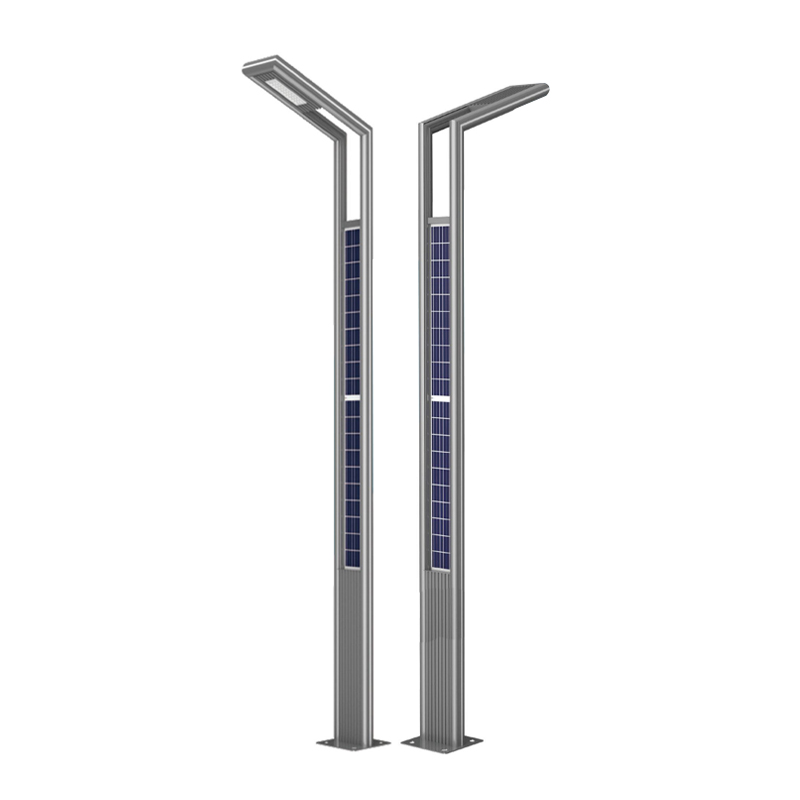 DDK-GN003 Double Sides Integrated Solar Aluminium Pole
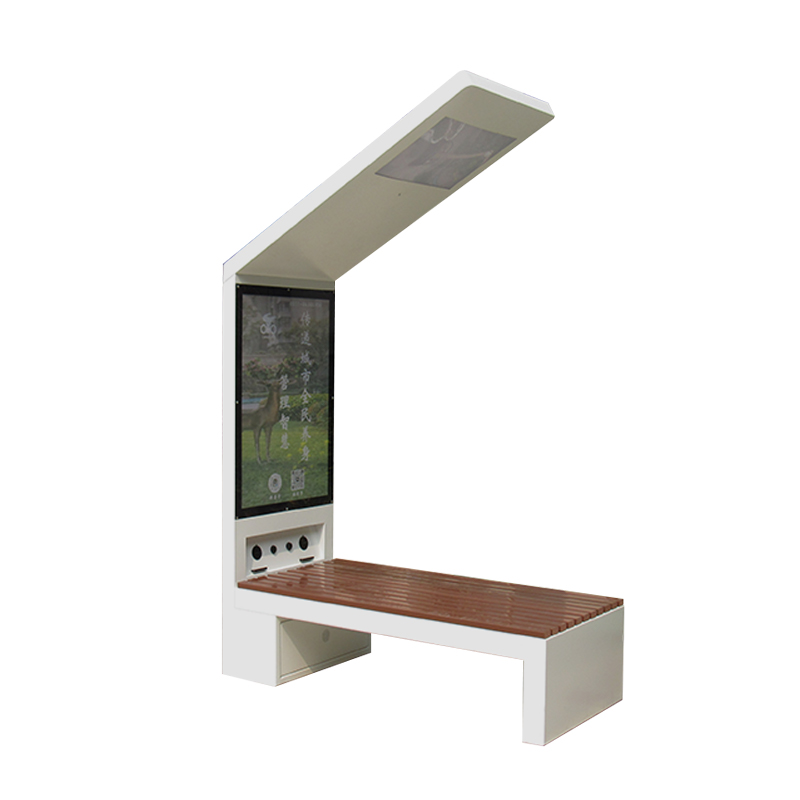 DDK-2000A Charging WIFI Solar Bench Outdoor Bench with Roof on the Top
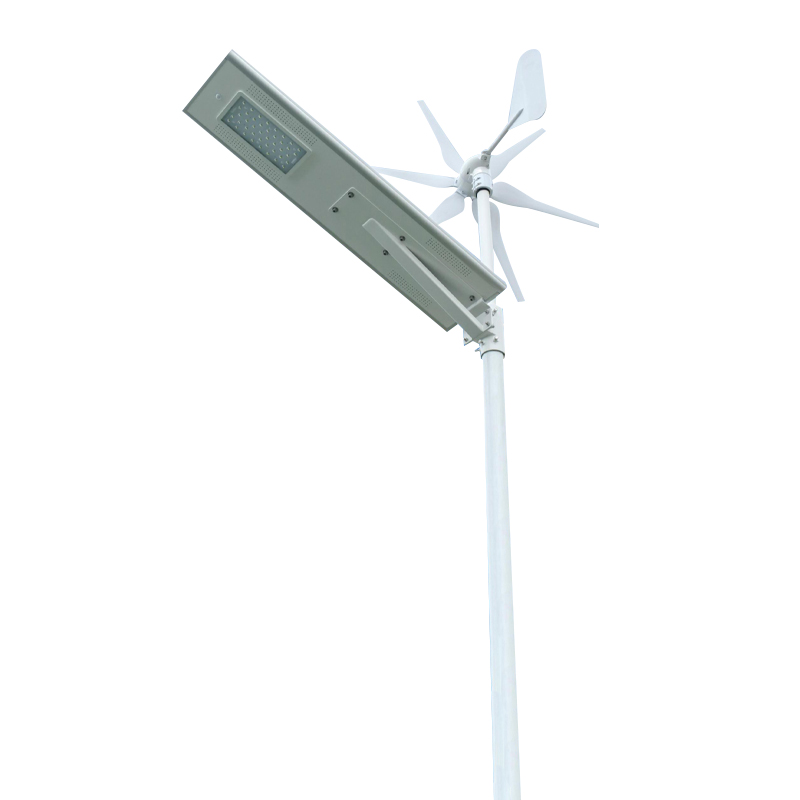 DDK G01 Solar&Wind Hybrid Integrated Optical Lens Solar All in One Light
 Customized Round Hexagon Octagonal Square Steel Street Light Poles for Outdoor Lightings
 3 to 16M Galvanized Steel Hinged Poles
Contact us
180 meters south of the intersection of Nanbei Avenue and Xuba Road, Gaoyou City, Yangzhou City, Jiangsu Province, China.
+86-18811954888
ddk@cnddk.net
 English
 русский
 Español
 عربى

