
call us
+86-18811954888
2026-05-14
Light poles range from 3 meters (10 feet) for residential garden and pathway applications to 40 meters (130 feet) or more for high mast stadium and highway interchange installations. Standard street light poles are typically 8 to 12 meters (26 to 40 feet) for residential and arterial roads, while parking lot poles run 6 to 10 meters (20 to 33 feet). Understanding the correct height for each application is essential before procurement because pole height directly determines the illuminance level at ground, the number of poles required, and the foundation specification needed to resist wind loading at the given height.
For Solar Poles that mount a Solar Panel alongside or atop a lighting fixture, the optimum angle for solar panels in the continental United States ranges from approximately 25 degrees in Florida (latitude 25 to 30 degrees North) to 47 degrees in Montana and North Dakota (latitude 45 to 49 degrees North). The direction is true south in the Northern Hemisphere for fixed-tilt installations. For any specific zip code in the United States, the National Renewable Energy Laboratory (NREL) PVWatts calculator provides the exact solar resource and optimal tilt angle for that location, eliminating guesswork from Solar Panel specification on Solar Poles.
This guide covers all these topics in practical detail: standard light pole heights by application, the major types of lampposts and their engineering differences, how Solar Poles work as an integrated system, how to determine the correct solar panel direction by zip code, and how to calculate the optimum angle for solar panels for maximum annual energy yield.
The question of how tall are light poles cannot be answered with a single number because the correct mounting height depends on the application: the target illuminance level on the ground, the spacing between poles, the width of the area being illuminated, and the photometric distribution of the luminaire being mounted. Each combination of these variables produces a unique optimal pole height that balances coverage, uniformity, and glare control.
Residential neighborhood street lighting uses the shortest pole heights of any public road application. Standard residential street light poles in the United States and Europe are typically 5 to 8 meters (16 to 26 feet) tall, with 6 meters being the most widely specified height for standard residential streets with carriageway widths of 6 to 8 meters. At this height, a standard LED road luminaire with a type II or type III photometric distribution provides adequate illuminance on the carriageway and adjacent footpath with pole spacings of 25 to 35 meters.
Pathway and pedestrian-only lighting uses even shorter poles, typically 3 to 5 meters (10 to 16 feet), because the target illuminance for pedestrian areas is lower than for vehicle carriageways and because lower mounting heights provide a more human-scaled, intimate visual environment appropriate for parks, plazas, and residential gardens. Bollard-style post top fixtures in the 0.6 to 1.2 meter height range define the lowest end of the pathway lighting category and are used primarily for edge demarcation rather than general illumination.
Commercial streets, arterial roads, and urban collector streets require higher mounting heights than residential streets to provide adequate illuminance across wider carriageways and to maintain acceptable uniformity ratios across multiple travel lanes. Standard mounting heights for commercial street and arterial road lighting are 8 to 12 meters (26 to 40 feet), with 10 meters being the most commonly specified height for dual-lane arterial roads with carriageway widths of 10 to 14 meters.
For divided highways and dual carriageway roads where poles are placed in the central median and must illuminate traffic in both directions from a single pole, the standard mounting height increases to 12 to 14 meters (40 to 46 feet) with double-arm bracket configurations that extend the luminaires over each carriageway. This configuration reduces the total pole count for divided road sections by approximately 40% compared to single-arm roadside mounting, significantly reducing installation cost.
Parking lot light poles are typically 6 to 10 meters (20 to 33 feet) tall, with the specific height selected based on the parking lot layout, the required illuminance level (typically 10 to 50 foot-candles at grade depending on security requirements), and the luminaire photometric distribution. Lower mounting heights (6 to 7 meters) are common in residential parking areas where minimizing light spillover to adjacent properties is a design priority. Higher mounting heights (8 to 10 meters) are used in commercial and retail parking areas where wider spacing between poles is desirable to reduce the number of poles and foundations in a large lot.
Sports field lighting poles for community recreation and school facilities range from 12 to 20 meters (40 to 65 feet) to achieve the mounting heights needed for professional-grade illuminance levels on playing fields without excessive glare on players looking upfield toward the luminaires. Professional and stadium-level sports facilities use specialized tower structures at 20 to 45 meters (65 to 150 feet) depending on the sport and the required illuminance level (up to 2,000 lux for broadcast-quality television coverage of major events).
High mast lighting poles for highway interchanges, port facilities, airport aprons, and large industrial yards range from 20 to 40 meters (65 to 130 feet) in height, with luminaire ring assemblies of 6 to 20 luminaires per pole that together illuminate areas of up to 30,000 square meters from a single pole location.
| Application | Typical Height (meters) | Typical Height (feet) | Typical Pole Spacing |
|---|---|---|---|
| Garden and pathway bollard | 0.6 to 1.2 | 2 to 4 | 4 to 8 m |
| Pedestrian walkway | 3 to 5 | 10 to 16 | 15 to 25 m |
| Residential street | 5 to 8 | 16 to 26 | 25 to 35 m |
| Parking lot | 6 to 10 | 20 to 33 | 20 to 30 m |
| Arterial road | 8 to 12 | 26 to 40 | 30 to 45 m |
| Sports field (community) | 12 to 20 | 40 to 65 | Layout dependent |
| High mast (highway interchange) | 20 to 40 | 65 to 130 | Single pole covers large area |
The types of lampposts in use today span a range from traditional decorative cast iron designs to modern engineered steel and aluminum structures, each suited to different aesthetic, structural, and functional requirements. Understanding the major types of lampposts allows specifiers, municipalities, and property owners to match pole type to application requirements rather than defaulting to the most familiar or lowest-cost option.
The standard utility lamppost for most modern road and parking lighting applications is the straight tapered steel or aluminum pole. These poles are manufactured by rolling and welding steel plate (for galvanized steel models) or extruding aluminum billets (for aluminum models) into a conical taper that reduces from a larger base diameter to a smaller tip diameter. The taper improves structural efficiency by concentrating material where bending stress is highest (at the base) and reducing material where stress is lowest (at the tip).
Galvanized steel tapered poles are the most widely used lamppost type globally because they provide excellent structural performance at the lowest material cost per meter of height. Hot-dip galvanizing to ASTM A123 provides 85 to 140 microns of zinc coating that protects the underlying steel for 20 to 30 years in most atmospheric conditions before recoating becomes necessary. Aluminum tapered poles cost approximately 30% to 50% more than equivalent steel poles but require no surface treatment and resist corrosion indefinitely in all but the most aggressive industrial and marine environments, making them the preferred choice for coastal installations.
Decorative lampposts are used in historic districts, town centers, shopping streets, plazas, parks, and any installation where the lamppost itself must contribute to the aesthetic character of the environment rather than being a purely utilitarian structure. The major materials used in decorative and heritage types of lampposts are:
Spun concrete poles are a major category of types of lampposts used in developing markets and in some high-traffic highway applications in developed markets where their very low cost and zero maintenance requirements outweigh their disadvantages of heavyweight and limited aesthetic flexibility. Prestressed spun concrete poles are manufactured by pouring concrete into a spinning cylindrical mold that uses centrifugal force to consolidate the mix around a prestressed steel wire core. The resulting pole is strong, durable, and requires no surface maintenance, but is very heavy, difficult to transport to remote sites, and cannot be powder-coated or easily modified after manufacture.
For parking lots, commercial properties, and light industrial facilities where moderate structural performance and competitive cost are both important, octagonal straight steel poles are widely specified. The eight-sided cross-section provides better resistance to wind-induced vibration than circular cross-sections of equivalent wall thickness, because the octagonal geometry breaks up the vortex shedding that causes circular poles to oscillate at certain wind speeds (a phenomenon called Karman vortex resonance that has caused fatigue failures in circular pole installations in high-wind regions).
| Lamppost Type | Material | Relative Cost | Maintenance Need | Best Application |
|---|---|---|---|---|
| Galvanized steel tapered | Steel, galvanized | Low | Low to medium | Road, highway, general utility |
| Aluminum tapered | Extruded aluminum | Medium | Very low | Coastal, premium installations |
| Cast iron decorative | Cast iron | High | High (regular painting) | Historic districts, heritage projects |
| Cast aluminum decorative | Cast aluminum | Medium-High | Low | Urban plazas, town centers |
| Spun concrete | Prestressed concrete | Very low | Very low | Developing markets, rural roads |
| FRP composite | Fiberglass polymer | High | Very low | Coastal, chemical environments |
Solar Poles combine the structural function of a conventional light pole with an integrated Solar Panel that generates the electrical energy to power the luminaire, a battery system that stores energy collected during daylight for use at night, and an intelligent controller that manages energy flow between the Solar Panel, battery, and luminaire to maximize reliable lighting hours regardless of daily variation in solar irradiance.
Every Solar Pole system integrates the following components, and the specification of each component determines the system's reliability, autonomy (how many consecutive cloudy days it can operate without recharging), and total cost:
The optimum angle for solar panels is the tilt angle (measured from horizontal) at which a fixed-tilt Solar Panel captures the maximum total solar radiation over the full year for a given geographic location. This angle is determined by the latitude of the installation and the solar declination variation throughout the year.
The sun's altitude in the sky at solar noon (when it is highest in the sky and at due south in the Northern Hemisphere) varies with the latitude of the observer and with the season. At the equator (latitude 0 degrees), the sun passes directly overhead at solar noon during the equinoxes. At latitude 45 degrees North (the approximate latitude of Minneapolis, Minnesota, or Milan, Italy), the sun is 45 degrees above the horizon at solar noon during the equinoxes, and lower in winter, higher in summer.
A fixed-tilt Solar Panel captures maximum solar radiation when it is oriented perpendicular to the sun's rays. Since the sun's average elevation angle over the year equals the complement of the latitude (90 degrees minus the latitude), the optimum angle for solar panels at a given location is approximately equal to the local latitude angle. At latitude 35 degrees North (approximately the latitude of Los Angeles, California, or Tokyo, Japan), the optimum annual tilt angle is approximately 33 to 37 degrees. At latitude 51 degrees North (approximately the latitude of London, England, or Calgary, Canada), the optimum annual tilt angle is approximately 49 to 53 degrees.
Research and simulation data from NREL and from the PVWatts tool confirm that the empirical relationship between latitude and optimum tilt angle for annual yield maximization in most locations follows the pattern:
The yield penalty for being off the optimum angle by plus or minus 5 degrees is typically only 1% to 3% of annual yield, which means that practical constraints such as structural convenience, aesthetics, or the need for a fixed-angle bracket on a Solar Pole can be accommodated without significant energy production sacrifice. The yield penalty becomes more significant for deviations larger than 10 to 15 degrees from the optimum, particularly for south-facing panels in the Northern Hemisphere where a 20-degree deviation from optimum tilt reduces annual yield by 5% to 10%.
| US Region | Representative City | Approximate Latitude | Optimum Annual Tilt | Annual Peak Sun Hours |
|---|---|---|---|---|
| South Florida | Miami, FL | 25.8 degrees N | 25 to 27 degrees | 5.3 to 5.6 |
| Southwest | Phoenix, AZ | 33.4 degrees N | 32 to 35 degrees | 6.0 to 6.5 |
| Southeast | Atlanta, GA | 33.7 degrees N | 32 to 36 degrees | 4.8 to 5.2 |
| Mid-Atlantic | Washington, DC | 38.9 degrees N | 37 to 42 degrees | 4.5 to 4.8 |
| Midwest | Chicago, IL | 41.9 degrees N | 40 to 44 degrees | 4.1 to 4.5 |
| Pacific Northwest | Seattle, WA | 47.6 degrees N | 45 to 50 degrees | 3.5 to 4.0 |
| Northern Plains | Fargo, ND | 46.9 degrees N | 45 to 49 degrees | 4.3 to 4.7 |
Finding the precise solar panel direction by zip code for any location in the United States requires using one of the publicly available solar resource analysis tools that calculate the optimal orientation and estimated annual energy yield for a Solar Panel at specific geographic coordinates. The most authoritative and widely used tool is NREL's PVWatts Calculator, which is freely available online and calculates the expected annual AC energy output and capacity factor for a Solar Panel system at any US location.
For most continental US locations, the PVWatts optimum tilt angle result will be within 2 to 4 degrees of the site latitude, confirming the latitude-equals-optimum-tilt rule of thumb as a practical starting point. Locations with significant cloud cover in specific seasons (such as the Pacific Northwest with heavy winter cloud) may show a slightly different optimum from the simple latitude rule because the solar resource is not uniformly distributed across the four seasons.
When mounting a Solar Panel on a Solar Pole, the optimal orientation calculated from PVWatts should be implemented in the pole-mounted bracket design. However, Solar Pole installations have specific practical constraints that sometimes modify the theoretical optimum:
Correctly sizing a Solar Pole for off-grid lighting requires calculating the system's energy demand (from the LED luminaire power rating and the required operating hours per night), the solar energy available at the site, the battery storage needed for the required autonomy (number of consecutive cloudy days the system must operate without sun), and the Solar Panel area needed to reliably recharge the battery under the site's typical solar conditions.
Standard residential street light poles are typically 5 to 8 meters (16 to 26 feet) tall, with 6 meters being the most widely specified height for standard residential streets with single-lane carriageway widths of 6 to 8 meters. At this height, standard LED road luminaires with type II or type III photometric distributions provide the target illuminance for residential streets (typically 5 to 15 lux average maintained illuminance depending on the applicable road lighting standard) at pole spacings of 25 to 35 meters.
The main types of lampposts in modern urban environments are: galvanized steel tapered poles for general road lighting (the most widely used type globally due to their combination of structural performance and low cost); aluminum tapered poles for coastal and premium installations requiring corrosion resistance without maintenance; cast aluminum decorative poles for town centers, plazas, and shopping streets where aesthetics are as important as function; FRP composite poles for chemically aggressive environments; and spun concrete poles in developing markets where minimal maintenance and very low cost are the primary drivers. Solar Poles represent a growing category that can be configured in any of these structural forms with the addition of Solar Panel and battery components.
At latitude 35 degrees North (approximately Los Angeles, California; Dallas, Texas; or Tokyo, Japan), the optimum angle for solar panels for maximum annual energy yield is approximately 33 to 37 degrees from horizontal, which is close to but slightly above the local latitude angle. This tilt is the result of the asymmetry between summer and winter solar paths at this latitude: summer brings a very high sun angle with long days that can be captured at lower tilt angles, while winter brings a low sun angle with short days that benefits from higher tilt angles, and the optimal annual balance falls slightly above the latitude angle at these mid-latitude locations.
The most accurate method to find solar panel direction by zip code is to use the NREL PVWatts Calculator at pvwatts.nrel.gov. Enter your zip code, set the panel azimuth to 180 degrees (true south), vary the tilt angle in 5-degree increments, and note the annual energy output at each tilt. The tilt that produces maximum annual output is your site-specific optimum angle for solar panels. Remember that the PVWatts azimuth uses true north as zero, so 180 degrees corresponds to true south. Magnetic south differs from true south by the local magnetic declination value, which must be applied if you are using a compass to orient the panel.
Solar Poles work by collecting solar energy through a Solar Panel mounted on the pole structure, storing the energy in an onboard battery system, and using that stored energy to power an LED luminaire during nighttime hours. An intelligent charge controller manages the energy flow, adapting the luminaire's brightness based on battery state and time of night to maximize reliability. The structural pole components have service lives of 20 to 30 years matching conventional lampposts. The Solar Panel has a typical performance warranty life of 25 years. LED luminaires last 50,000 to 100,000 hours. LiFePO4 batteries require replacement every 7 to 10 years, which is the most frequent maintenance event in the Solar Pole's lifecycle.
Solar Poles are generally more cost-effective than grid-connected lighting when the cost of trenching for underground electrical cables is high, when the installation site is remote from existing electrical infrastructure, or when the applicable electricity tariff is high. The capital cost of a Solar Pole system is typically 30% to 60% higher than a grid-connected equivalent per pole, but this premium is offset by the elimination of trenching civil cost (which typically represents 40% to 60% of total grid-connected installation cost) and the elimination of ongoing electricity costs over the system's service life. For sites where grid connection costs are low and electricity tariffs are low, the economics favor grid-connected systems.
Yes, both the tilt angle and the direction (azimuth) of a Solar Panel are important for maximizing energy yield. In the Northern Hemisphere, a Solar Panel should face true south (azimuth 180 degrees) to maximize exposure to the sun's path across the sky. Facing east or west of true south significantly reduces annual energy output: a panel facing southeast or southwest (45 degrees off true south) captures approximately 90% to 93% of the energy of a true south-facing panel at the optimum tilt. A panel facing true east or west captures only approximately 75% to 80% of the energy of the optimal south-facing panel. The solar panel direction by zip code tool confirms true south for any location while accounting for local factors.
A Solar Pole is a fully integrated self-contained lighting system where the Solar Panel, battery, controller, and luminaire are all designed and engineered to function together as a single system, with the pole structure designed to carry the wind loading of the Solar Panel and to integrate the battery compartment within the pole base or a purpose-designed housing. A conventional light pole with a separate solar power connection is a hybrid arrangement where the pole was originally designed for grid-connected service and a Solar Panel has been added as an afterthought, often with a surface-mounted battery box and charging controller that may not be structurally integrated or optimally specified for the pole's geographic location and illuminance requirements. Purpose-built Solar Poles provide better performance, better aesthetics, and longer service lives than converted conventional poles in most applications.
Solar Poles can work reliably in northern states including Minnesota, Wisconsin, Michigan, and the Pacific Northwest, but they must be sized appropriately for the lower winter solar resource in these locations. Key design adaptations for northern Solar Pole installations include: larger Solar Panel capacity to capture adequate energy during short winter days (increasing the panel-to-load ratio from the 1.2 to 1.5 typical of southern installations to 2.0 to 3.0 or higher); larger battery capacity to provide the required multi-day autonomy through extended cloudy periods; adaptive dimming controllers that reduce luminaire output during low-resource periods to extend autonomy; and careful optimization of the optimum angle for solar panels to prioritize winter energy capture by tilting the panel steeper than the latitude angle, accepting some summer yield reduction in exchange for improved winter performance.
Wind loading on a Solar Pole is significantly higher than on a conventional light pole of equivalent height because the Solar Panel mounted on the pole acts as a sail, generating substantial lateral force when wind blows perpendicular to the panel face. A 200-watt monocrystalline Solar Panel with dimensions of approximately 1.0 meter by 1.7 meters presents a projected area of 1.7 square meters to the wind. At a design wind speed of 45 m/s (a typical value for ASCE 7 category II wind zone), this panel face generates a wind force of approximately 2,500 to 3,500 Newtons on the panel bracket and pole top, which must be resisted by the pole structure and foundation. This additional loading typically requires a pole wall thickness 20% to 40% greater than an equivalent height conventional pole, and a foundation with a deeper embedment depth or a larger concrete base diameter to resist the higher overturning moment at grade.
Related Products
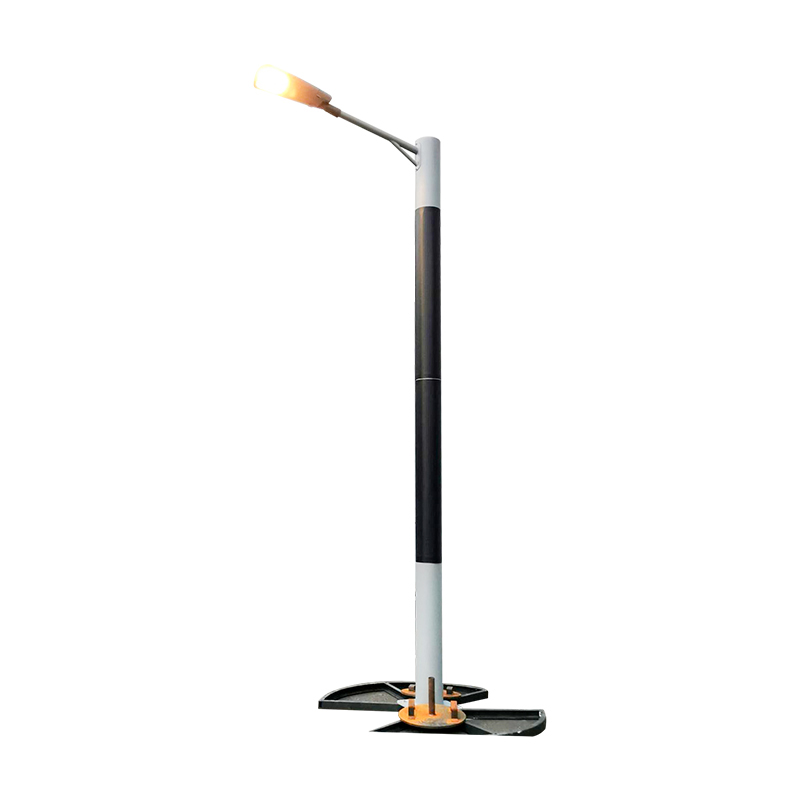 DDK-SSPL-2000 Cylinder Solar Pole Single/Double Arms And Street LED Lamps
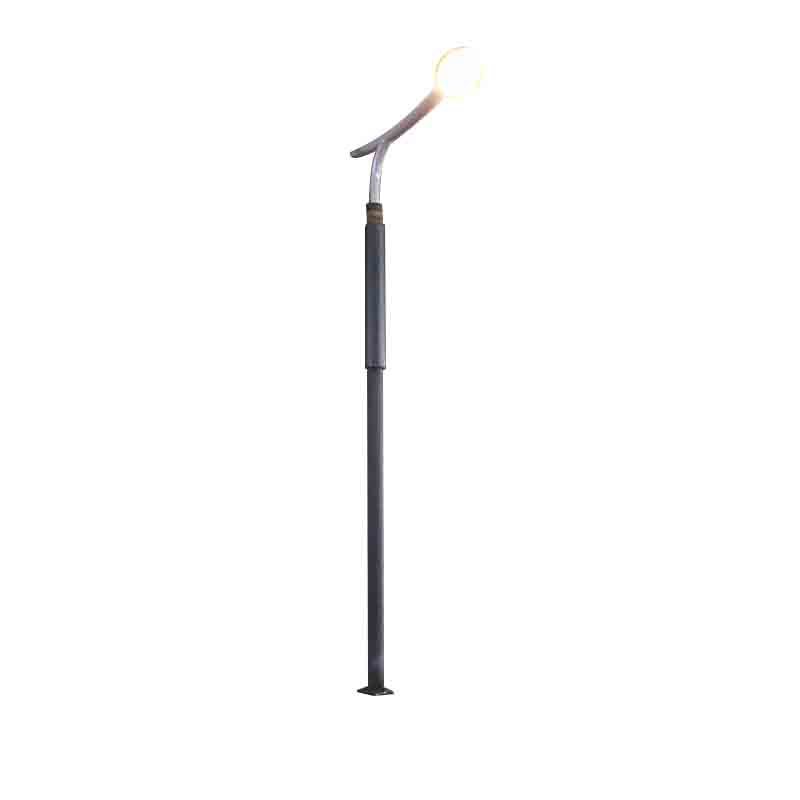 DDK-SSPL-2002 Cylinder Solar Pole With Lamp Head
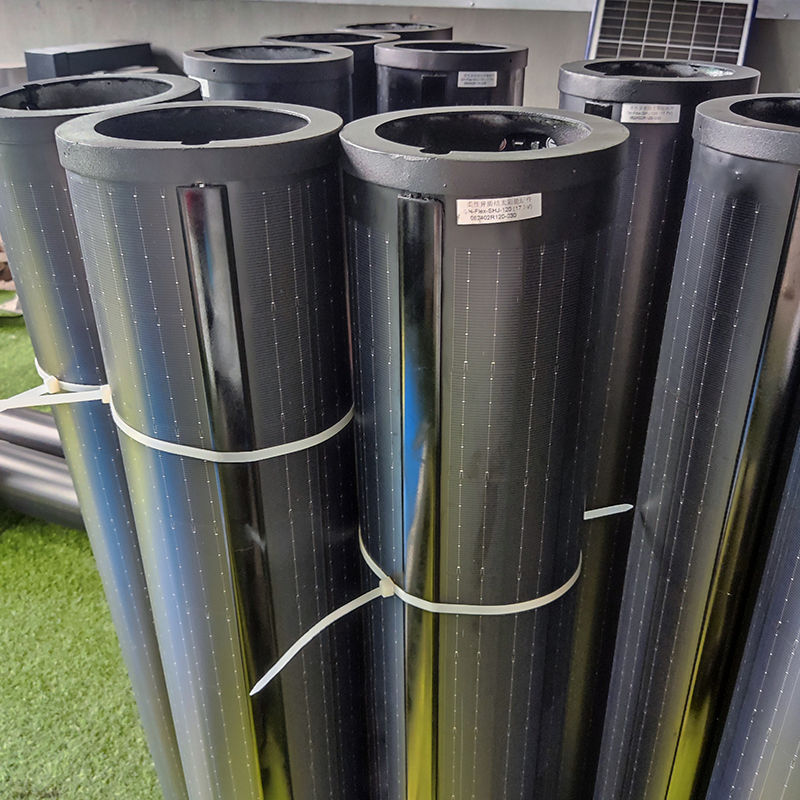 140W Flexible Solar Panel: High-Performance, Elegant and Versatile Power Solution for Lighting Poles and Park Lightings
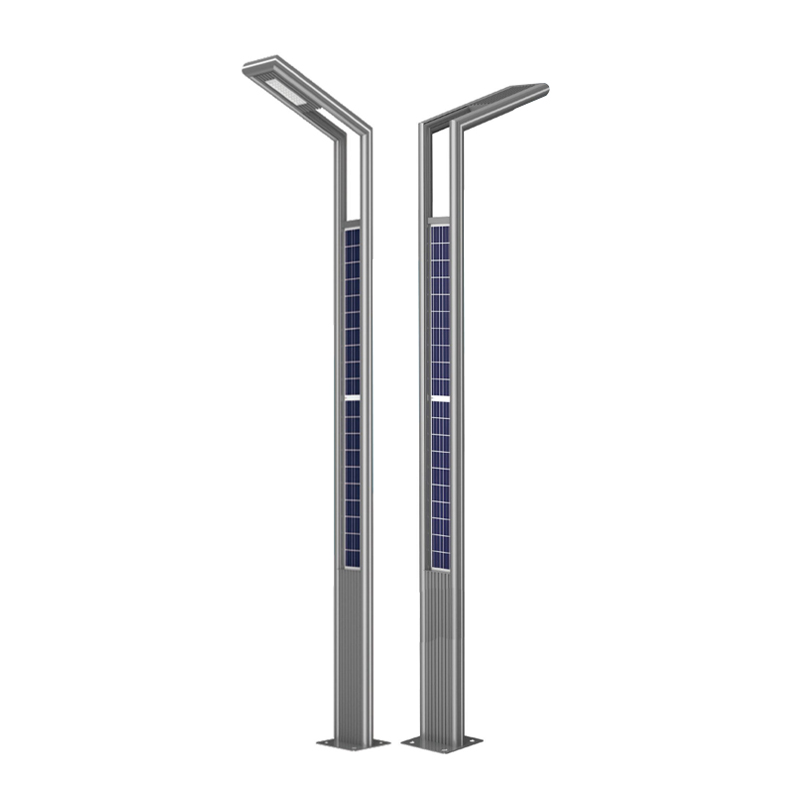 DDK-GN003 Double Sides Integrated Solar Aluminium Pole
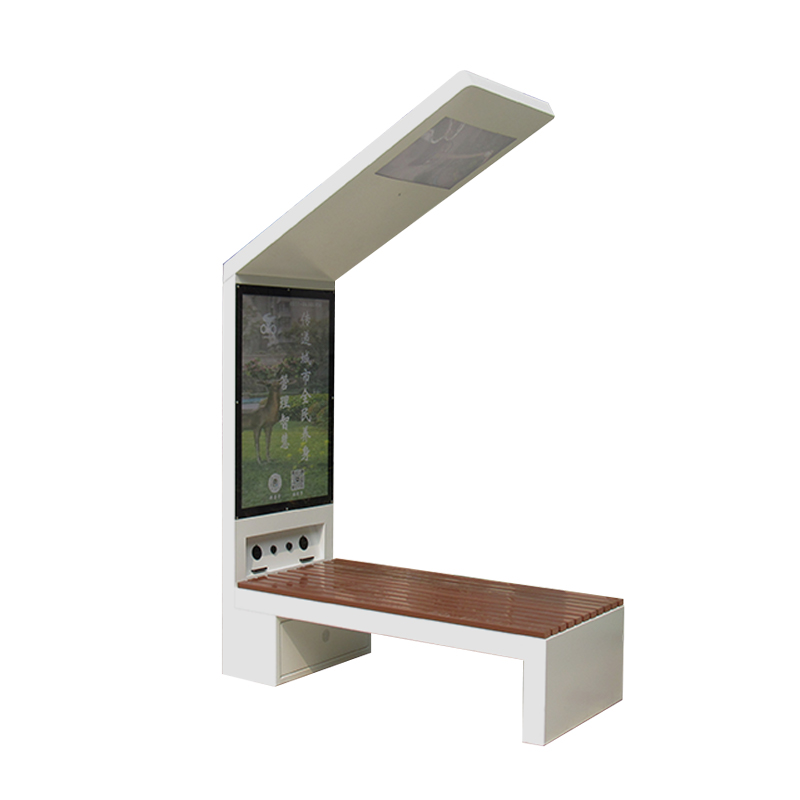 DDK-2000A Charging WIFI Solar Bench Outdoor Bench with Roof on the Top
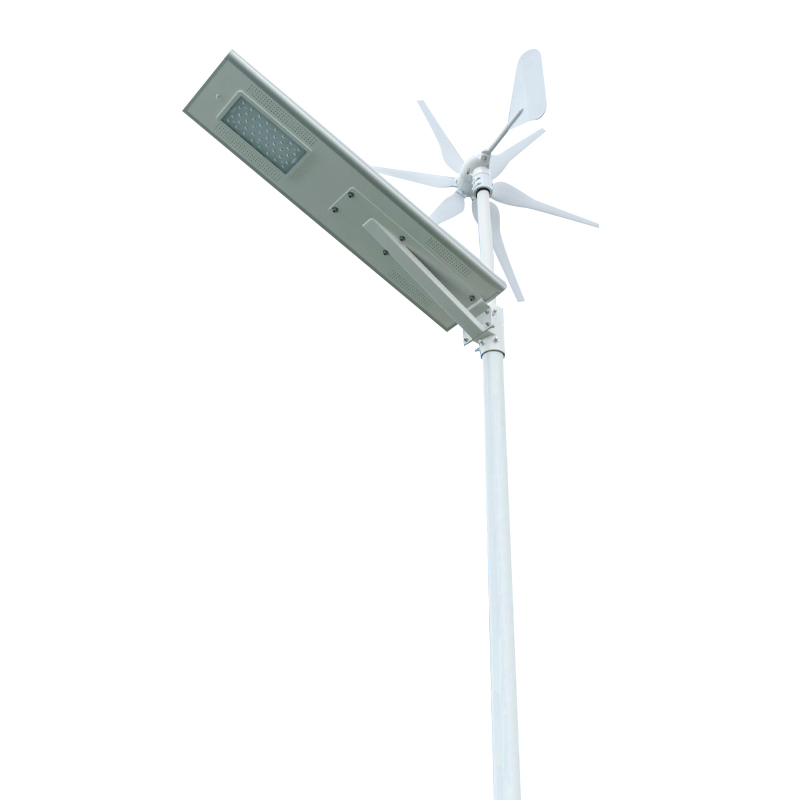 DDK G01 Solar&Wind Hybrid Integrated Optical Lens Solar All in One Light
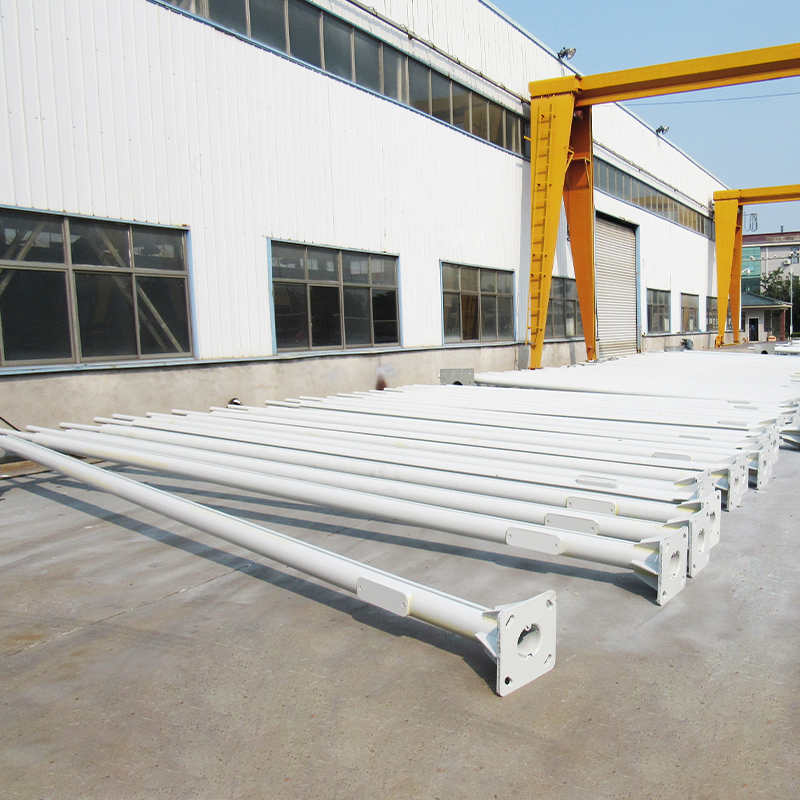 Customized Round Hexagon Octagonal Square Steel Street Light Poles for Outdoor Lightings
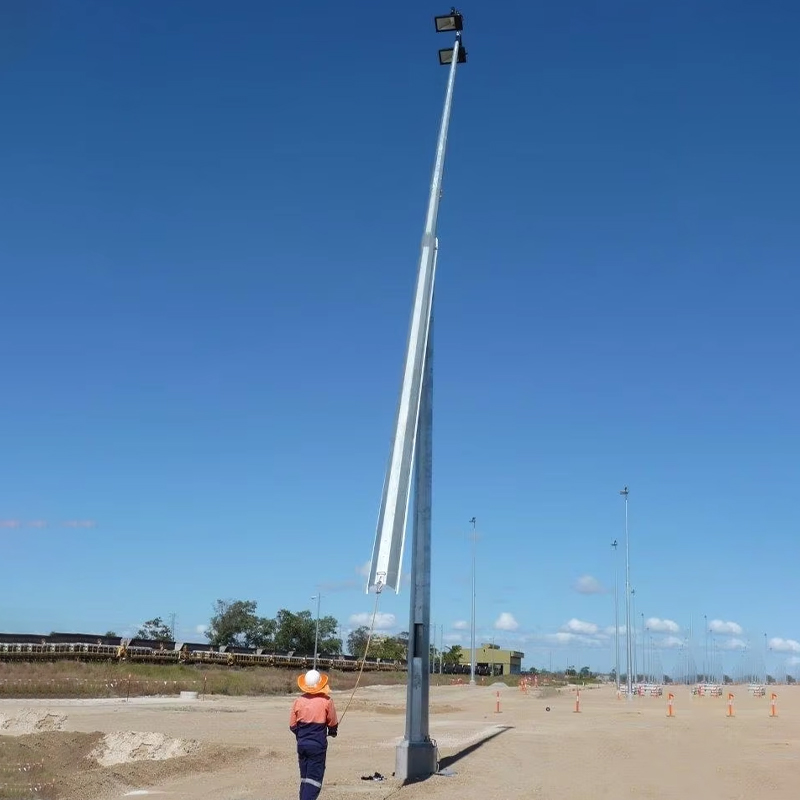 3 to 16M Galvanized Steel Hinged Poles
Contact us
180 meters south of the intersection of Nanbei Avenue and Xuba Road, Gaoyou City, Yangzhou City, Jiangsu Province, China.
+86-18811954888
ddk@cnddk.net
 English
 русский
 Español
 عربى
عربى

